Saturday, May 7, 2011

Digging Paint

by Stephen Cummings

Ryan Peter Miller, 2010, Stegosaurus

Ryan Miller's a smart ass. (That's Ryan Peter Miller, sorry. Probably a union thing.) When I first saw his work in 2007 I called him Mr. Contemporary Art — whatever that can mean. There was an attitude in the work that set him apart from his then MFA colleagues. On the walls of his open studio hung small panels that took shots at artists and movements and even painting media with the brand of ironic iconoclasm that's proven important over the past few decades. Most prominent in my memory are a Warholian sort of memento mori that turned childish things oddly serious in its poking fun at encaustic paint, and an aggressively blunt poke at — well, if not everything, at least a lot of things. It was funny, and snarky, and maybe a bit much at times, but it stayed with you. All this work was organized into a pair of Ain'ting shows in that and the following year, so you'll probably remember it if you happened to be in Phoenix/Tempe at the time, lookin' at art.

I paid a fresh visit to Miller's studio recently and was happy to see he's still dripping, molding, pushing paint together in ways related to but quite distinct from those Margie Livingston started playing around with — and getting praise for — a couple of years after. These aren't just pretty pictures — well, objects; Miller has more of an agenda, more of an awareness, and more of a sense of humor. One work in progress is half paint half mustard; another casts acrylic as paper. The attitude is out in front in works like these, but the pieces that really caught my eye were slightly more lighthearted: a series of, of all things, dinosaurs. [1]

In this group of panels, Miller is creating images — as opposed to objects with an emphasis on their own objecthood — but he's hardly painting a picture in the traditional sense. Each panel consists of layers and layers and layers of thinly applied acrylic, strata that have been carved into to reveal the visages of these prehistoric behemoths. He's digging for dinosaurs; it's funny. The quality of these super simplified pictures reminds me of postage stamps for some reason — three foot width notwithstanding — but they're maybe more reminiscent of the old game graphics that appeared as primitive lines of color on our early '90s TV screens. That, and the fact that we're looking at dinosaurs, a childhood favorite, takes us back, as the paint takes us literally back into the painting surface, into its own history. Things start to get tangled up quickly in these, maybe part of their appeal, but equally important is that the panels are just gorgeous. The surfaces glisten, milky and tactile, and there's something mysterious and stimulating about those hollowed-out troughs of color, reminiscent in their flickering juxtapositions of the divisionism of Georges Seurat or Chuck Close, an unexpected treat. The paintings were displayed in Chandler last year, so maybe you saw them then, but if you didn't (as I didn't) they're well worth seeking out.

So keep an eye out for Miller; his is a an active mind with a sharp wit. And if he's occasionally heavy-handed in his protests, at least he has the chops to make the experience one to indulge in.

  1. I'm nerd enough that I feel obliged to point out that Pteranodons are not dinosaurs, strictly speaking, but pterosaurs. Please forgive me the use of the catch all.

Saturday, April 30, 2011

Fundamental Truths

by Sean Flannigan
Jon Krakauer, 2003, Under The Banner of Heaven

Continuing on the thread of books I've recently read, I will present a book wholly different than my last, and in the realm of nonfiction. This time I read Jon Krakauer's Under the Banner of Heaven: A Story of Violent Faith. The book's central focus is on the horrific murder of Brenda Lafferty and her infant child Erica. They were killed by Dan and Ron Lafferty, Brenda's brother-in-laws, who were commanded personally to do so by God, or their God at least, the one that speaks into their brains. The Lafferty brothers are Mormons, but that is too simple. They are fundamentalist Mormons, part of one of the ubiquitous sects of the dry West, dividing like cells, spawned by multitudes of differing revelations. From this one detestable act, described throughout the book from all available sources including the brothers themselves, Krakauer shines a light on the violent past and present of this relatively new pariah of a religion.

I say pariah, but in more recent years it has gained a great deal of traction. We've even had, and will have, a possible presidential contender who is of the faith. Mormonism is growing exponentially, much thanks owing to their responsibility to mimic the reproduction of rabbits. More children, more workers, more believers. They send missionaries out across the nation, and further into all the nooks and crannies of the world, suited-up in black and white and kindly asking for everyone's hand in theological union. This, though, wasn't the case at Mormonism's conception, inside an old hat with the face of Joseph Smith, who spoke with confidence of the existence of buried golden plates left by an angel called Moroni. The wild revelations of Joseph Smith needed time to lay down roots in the minds of the people.

It is that beginning, the creation of The Book of Mormon, and the ensuing struggle for legitimacy that Krakauer explores in an effort to explain the phenomenon of Mormonism's fundamentalist progeny. It seemed to me a very level analysis and history of a very guarded and temperamental faith, both the main Latter-Day Saints church and their unintentional polygamist offspring. Krakauer did a great deal of research in order to confidently write about an ever-present but not widely understood religion, using the Mormons' own well-recorded histories and religious texts as well as highly regarded books and personal interviews. The picture that emerges, from Joseph Smith's small band of followers to the more recent polygamist sects, is that of a extremely well-run and tremendously paranoid cult whose power structure at times resembles that of the mafia.

Personally, I couldn't put the book down. It was engrossing, suspenseful and disturbing; a story so strange it had to be real. Like all great sociological or anthropological studies, Under the Banner of Heaven illustrates the malleability of human consciousness under the sway of an ideological construct. A convincing origin story, or at least one which stirs the audience's heart, can evolve (or mutate) into something grander (or more monstrous), given the right circumstances. This is the case with Mormonism, born on the back of a crooked con artist (historically verified) and sold with the gusto of the best Evangelical pastor.

And this is not to single out this one particular religion. The most populous religions, the ones which rule the world's theological pie-charts, all have histories of great crookedness and horrid violence. None should be off the hook. The only difference is those who own much of the pie are the ones whose histories are just large enough to build a religion yet too sparse and ancient to build a case against. The truth is that no-one can scientifically say that any virgin births occurred, ever, or that the supposed product of said unverified event was reborn three days after he died in the company of criminals. The story put forth by Joseph Smith was crazy because it was crazy, but also because it was unfamiliar. Who is to say what is familiar isn't also improbable and crazy as well?

Love it or hate it, Under the Banner of Heaven is an undeniably interesting read and you will know more for having read it. So, go read it.

Sunday, March 27, 2011

Recently Read

by Sean Flannigan

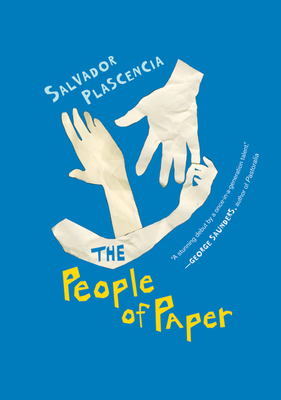
The People of Paper (McSweeney's Books, 2005)

A friend lent me this book by Salvador Plascencia, thought I'd like it, as he returned to me my copy of Kundera's Unbearable Lightness of Being. The book was overlarge where width and height were concerned, but a cursory glance through the relatively thin volume showed its post-modern flare, with ever-changing blocks of formatting, black shapes covering up some or all of certain narratives and small illustrations breaking up (and supposedly holding up) the story. These things excited me and I began reading it the next day.

The book centers around Federico de la Fe, father and husband, who must change the straw in their mattress each Tuesday by the river for all the uncontrolled piss he makes at night. His wife, Merced (who loves limes), chooses not to be pissed on anymore and leaves them both. The story springs from this sad point, the narrator changing with each column of text, from Little Merced (the daughter) to Rita Hayworth to Baby Nostradamus and more. Federico tempers his sadness by burning himself, which he hides from Little Merced (who also loves limes). This works for him and he always wears long sleeves. The main narrator is Saturn, that third-person omniscient whom Federico blames for everything, and whom Federico wages a war against with the carnation-chewing gang of the town of El Monte in Southern California. Saturn sees everything, hears everything, is making a history of their lives with his voyeurism.

Oh, yes, there are also the people of paper. A highly skilled origami artist began by reanimating his dead cat with paper organs and paper arteries before working his way up to human organs, and finally whole people of paper (whose fellators develop paper cuts on their tongues or wake up with soggy newspaper skin stuck to them overnight).

Needless to say, there are a great deal of creative elements at work in this book, so much so that to be brief about it is to sound a little ridiculous. His language is something like I have never read, totally casual yet thick with imagination, self-aware but not grievously meta. He brings the reader into a world occupied by obvious creation, occupied by the writer himself. It is a book mired in the sadness of loss and the futility of displaced anger. The characters and their struggles are tied to all who involve themselves in the story and illustrate how personal the act of writing fiction is.

Overall, I would recommend picking it up and giving it a try. It is something different, a little fantastical and very smart.

I will conclude with a small passage from the beginning that I just turned to:

Saturn

Saturn was aligned directly over Federico de la Fe, following him wherever he went, budging a half a space centimeter for every five hundred land miles de la Fe and Little Merced traveled. But once Federico de la Fe retreated into the lead shell, safely hiding from view and refusing to reemerge until the weight from the air was lifted, Saturn withdrew into his orbit and faded into the blur of the chalky galaxy.

Monday, February 28, 2011

This Unassuming Drawing

by Stephen Cummings

Go see this drawing by Roberto Cuoghi.

How often do you come across a really good drawing? I mean a really good drawing. Something that grabs hold of you and won't let go. For me it's not that often. I think of Leonardo's portrait of The Virgin and Saint Anne, or Seurat's portrait of his mother. Maybe some of those spare, celebrated arrangements by Schiele? Don't get me wrong, there are plenty of great drawings out there, but some take it to another level. Fortunately you can see what I'm talking about, provided you get yourself over to the Hammer to have a look at one small piece by Italian artist Roberto Cuoghi.

It's a self portrait, like every piece in this particular body of work (unless that Pazuzu sculpture can be said to be included), and untitled like the rest of them as well. What makes it stand out is its solidity, its straightforwardness, and the absolutely exquisite handling of the materials.

Looking out from the page is the head of a heavyset man, with no pretense to anything else. And I should go further and say, a drawing of the head of a heavyset man, with no pretense to anything else. Lines unravel toward the edges of this paper like those of the old masters. This thing does not seek to be a window onto a world; it's a drawing. Marks bold and delicate make up the concentrated but serene figure. It's a confident draftsman who can allow the tiniest lower eyelashes to coexist on the page with a flattened haze of hair and fat lines around a fat neck. Moving across the face a near sculptural right eye composed of clear, concise marks gives way to the soft, sfumato whisper of the left side of the head, a rich, receding space cut out by the bold, dark lines that define the form's left edge. Because the crudeness of these lines brings us firmly to the surface of the paper, it's as if the face is sunk into the space beyond. Elsewhere can be found a stubble made not of stippled pigment, but of depressions poked into the page, possibly with the staples mentioned in the list of media. These same holes form pores in other areas, and in still others mere stippled value. In an otherwise graphite palette, the ear and cheek on the right side betray subtle hints of color, and the whole fleshy guise sits atop a collar pushed forward by its whiteness, whiteness achieved with help of that white-out tape you can find at office suppliers as well as some coarse scraping away of the paper. This drawing, in short, is a tour de force.

There are artists who take great pains to insist that virtuosic draftsmanship is superior to other forms of art. Their work is boastful and self-conscious and stale. And Cuoghi, with this matter-of-fact, fat beauty, displays a level of virtuosity that they can only dream of.

Sunday, February 6, 2011

Amidst All This Nothing

by Stephen Cummings

Paul Sietsema, 2009, Anticultural Positions

So word is that the staff at the Armand Hammer Museum in Los Angeles is all aflutter because a hummingbird built its nest in their courtyard. And while that in itself might have elicited a certain amount of excitement on any normal day, this little construction project happened to coincide with the installation of the Hammer's latest show, and in that show there is a piece which, in a one hour video, on a little Toshiba flat-screen, features — are you ready? — a hummingbird, asleep on a twig.

It's pretty magical.

All Of This And Nothing, which opened last week and runs through April 24th, features works by fourteen contemporary artists from LA and without. According to the museum, "these artists conceptually and emotionally invest simple [...] materials with a newfound poetic meaning while offering a thoughtful meditation on the fragility of our lives and the objects that make up the world around us." It's kind of a nebulous notion that, thought about from different angles, could describe a huge swath of the artwork from now or the past. But the show hangs together pretty well, though it does rely heavily on the assumption that certain things just are amazing.

For example, do you think it would be amazing to watch a hummingbird sleep? Well then you probably are going to find Fernando Ortega's video to be pretty amazing. (Though now of course you can watch in real life just outside the galleries. Undercut?) What about the idea of a spider weaving a web in place of a harp's strings? Then get ready for three dull photographs of just that, none more interesting than the next, and possibly less interesting as a series. With curatorial complicity, Ortega is absolutely the worst offender in this, staking his work almost entirely on our wholesale acceptance of his profundity. But it's not just him; from room to room too much is being made of things all over the place.

Evan Holloway took some real bad photos, but there they are on prominent display. Paul Sietsema's drawings are not bad by any objective test, but being told about the "obsessive" process of their making does not catapult these papers into the hyperbolic realm the curators see them occupying. Frances Stark makes good work, but the collages in this show are rather clunky. Yet it seems we are asked to regard them more highly simply because they depict the artist at work in her studio. And then there's Charles Gaines' Manifestos, in which he used historical texts as the basis for musical compositions through an arbitrarily applied system of assigning notes to letters. As Gaines himself admits, "I could do any text in the world [...] apply it to the system, and it would sound the same." So why this grand treatment? Is it necessary that these huge drawings of the specific texts and corresponding scores accompany the music? And four thirty-some inch flat screens perched oddly on hardboard podiums? Really? And why hardboard? I guess the artists is at fault here too though, having made those silly drawings in the first place. It's all just so . . . overblown. Perhaps one of the docents put it best when she said of the Ian Kiaer installation that opens the show, "You're supposed to kind of go back to when you were five in this room. I don't know why, but."

That said though, this show is very worth seeing. Gaines' piece is worth hearing, Sietsema's drawings are kind of interesting, and Ortega has a kinetic sculpture/installation on the ground level that makes you go, Huh. But more than that, amongst the smattering of glorified whatnot, a handful of pieces stand out as whole, and not overdone, and you are encouraged not to miss them.

In the third gallery sits the show's most commanding piece, a high, broad section of wall and doorway from the studio of Gedi Sibony. The Cutters exists in that tradition of assemblage begun by Robert Rauschenberg, but is a much more minimal, quiet, solitary thing, something akin to Agnes Martin or the drawings of Georges Seurat. Revealing little more than drywall, metal framing, primer, and some hanging canvas, the economy of language in this piece is striking. [1] Passing around and through it gives such a clear sense of its completeness that it's no wonder Sibony felt the need to physically cut it out of his work space. However he managed that, it was worth it; with a couple of other pieces offering an even greater economy of materials and arrangement, Sibony's presence in the museum has a singular authority.

Midway through the exhibition, Sergej Jensen offers up one of those minimal compositions that strikes an iconic position in your mind almost before you've become aware of it. One of his three contributions to the show, this particular untitled arrangement of various sewn fabrics reposes in a muted palette of grays. It's a constructed fitting together of rectangles that you almost feel like you've seen before. But this familiarity, while it may allow you to pass by without too much consideration at first, keeps the piece with you, and you may find a nagging urge to keep returning to it, if for nothing else than to figure out what you must have missed.

Toward the end of the show you will find Paul Sietsema's Anticultural Positions, a gorgeous black and white film featuring close-up stills of the surfaces of the artist's work tables intercut with text modified from a 1951 lecture of the same title by Jean Dubuffet. The pairing has the sort of arbitrariness that went into collaborations between John Cage and Merce Cunningham, and it has that sort of success too. These two inputs compliment one another. An exceedingly close examination that can be likened in some ways to Chuck Close is kept from being tedious by the addition of Dubuffet's words, and those words in turn seem to make an effort relate to the changing images that precede and follow. Despite the separation of half a century, these two languages hold together quite well.

And before you escape the circuit of galleries you will encounter at last the great white expanse of Karla Black's Once Cut, a broad field of plaster powder sprinkled evenly across the gallery floor and interrupted by the addition of a few colorful bath soaps and liquids. It's a thing that makes you stop and wonder about it, whether you're new to art and questioning whether any of this is art at all, or if you're more experienced and trying to decide whether this composition and its materials hold together the way you expect. In either case, one thing is sure, you won't be able to see it at all if you don't make it out to this show.

  1. The museum gets a little carried away again, stating, "Sibony conjures the magical from the mundane." But hasn't that been the nature of art since, you know, forever? Paint being essentially mud and all that. Silly museum.
  2. The original version of this post featured a paragraph about the work of Jorge Macchi. It has been removed after further viewing caused me to rethink such high praise.

Thursday, December 30, 2010

Art 2010: A Wandering Best Of

by Stephen Cummings

I didn't spend enough time in any one place this year to claim to present a synopsis of a region's best, but I did, in my wanderings, see a good deal of good art. (Mostly I was in Seattle.) Some have been praised already, both on this blog and off, and some I would be remiss if I let the year pass without giving them mention. So before the date turns, here are the best new things I came across in 2010, in no particular order.

A Tool To Deceive And Slaughter

Caleb Larsen, 2010, A Tool to Deceive and Slaughter

Early in the year I walked past a well-made black box in Seattle's Lawrimore Project and couldn't be bothered to examine it more closely. It was clearly related to Robert Morris's Box with the Sound of its Own Making, a fixture in Seattle Art Museum's Minimalism gallery, but the night was wearing on and I was eager to make my way home. Mistake. Only later did I learn in The New York Times Magazine that this piece by Caleb Larsen actually tries to sell itself on eBay . . . all the time. All the time? Yes. Once someone buys it, A Tool to Deceive and Slaughter sets up a new auction with a newly revised opening bid, and the owner is required to send the piece along once sale is made. A hilarious take on the consumerism that is the art market, I bid Larsen's Tool Godspeed in repeatedly raising its own price into perpetuity — or not — and pointing out one of the absurdities that has been made of art in our time.

Untitled (Shit Happens)

Another irreverent favorite, found in Indonesia, was Malaysian artist Ahmad Fuad Osman's presumably operational blender serving as home to a fish and a water plant. I hate to heap praise on an art star, but Untitled (Shit Happens) was so blunt, so cocky, so absurd, and so unsettling, I can't help but mention it again. The very real possibility of so easily snuffing out an unsuspecting, if inconsequential, little fish — and the neon letters seemingly taunting you to do so — is a surprisingly disturbing prospect. It's the kind of thing that makes people object. 'This isn't art!' (Notice it's not about the fish.) But it knows, and it loves it, and it is.

Love Fear Lust Pleasure Pain Glamour Death

Andy Warhol, 1965, Screen Test, Dennis Hopper

Also previously mentioned was Seattle Art Museum's staging of Love Fear Lust Pleasure Pain Glamour Death, a selection of photographs and short films by American master Andy Warhol. What was refreshing about this show was how much the museum stood back, and allowed the work to just be on display. Then of course, the work was powerful and enthralling all on its own. And in what ended up the humblest of curtain calls, Dennis Hopper's Screen Test was made more poignant with the coincidence of his death.

Chuck Close Prints

Chuck Close, 2010, Roy

In the other Washington, another American master. There's nothing surprising about a collection of Chuck Close's work coming off as impressive, large as it tends to be, but what was most impressive about Chuck Close Prints at the Corcoran Gallery was its deep insight into the art and process of printmaking. I worried at first that it would be instructive like that time Bobby Jindal talked to us all on national television, but the museum assumed no stupidity in its audience, and managed to present printmaking from its fundamentals to a number of elaborate and unconventional processes in a way that was both interesting and understandable — and not patronizing. The lens of Chuck Close's oeuvre offered an ideal and commanding structure for this heavy undertaking.

Wall

A very different deconstruction of process could be seen in March at Seattle's Western Bridge. In a three-day performance, Corin Hewitt cut, removed, reinforced, rearranged, and otherwise fiddled with the inner and outer portions of gallery walls where he could be observed both directly within the gallery and by closed circuit video from the outside. I preferred the video, in which objects became suddenly not themselves when they were revealed to be photographic reproductions, or stacks of the like, and photographs became objects as the mind lost track in the jumble. Unsurprisingly, it's not really about the wall.

A Dirt Crown Worth Its Weight

Bryan Schoneman, 2010, The Dust Settles: A Dirt Crown Worth Its Weight

Continuing a tradition of good work, Bryan Schoneman staged a thesis performance in the University of Washington's 3D4M Gallery in which he operated an oversized machine built solely for the purpose of pouring dirt onto his head. Schoneman may contradict me on this, but I'm convinced it's not really about the dirt. Instead, The Dust Settles seemed to be about the slow, eerily peaceful atmosphere arising from the artist's bizarre, trivial exertion. In either case, it later won an award. (Congratulations.) With any luck, galleries will learn to accommodate the mess so more of us can see Schoneman perform in the future. And if they don't, they'll miss out, because I'm sure he'll manage to find other venues.

Drawing Construction #2 (Shadow Boxing Compass)

The other highlight of the MFA season was Samuel Payne's installation and/or assemblage at the Henry Art Gallery's UW MFA Thesis Exhibition. (Full, if cryptic, disclosure: I was personally involved with this show.) Drawing Construction #2 (Shadow Boxing Compass) has been called overkill, but such is the specificity of Payne's language that this piece was anything but. Surely it was difficult to decipher, but Payne's work needs to be understood in the context of its past incarnations, and this piece built upon a personal iconography developed by the artist over the course of years. There were the paper covering that began on his studio wall, the shoes oriented maybe in cardinal directions to allude to his travels, the music stand from a number of previous pieces, the sound of chopping wood from — from who knows where. It's hard to be specific about this piece without being really specific, which is why I hope to write more about it in the future, if I can muster it. In the meantime, just envision a complicated conglomeration of recycled forms and works and memories.

Beat Memories

Speaking of memories, Allen Ginsberg took some photographs, and the National Gallery mounted an exhibition. If I am to mention a photography show, it would certainly be appropriate to include MoMA's first ever retrospective of Henri Cartier-Bresson, but we already knew he was a great photographer. Allen Ginsberg, the poet, was the more surprising. Plus, in addition to some darn good photography, each print included a hand-written caption of sorts, a little prose poem inseparable from the image, which added that much more richness to the experience. I'll let Ginsberg close us out, with the caption that stayed with me all the rest of the year.

I sat for decades at morning breakfast tea looking out my kitchen window, one day recognized my own world the familiar background, a giant wet brick-walled undersea Atlantis garden, waving ailanthus ("stinkweed") "Trees of Heaven," with chimney pots along Avenue A topped by Stuyvesant Town apartments' upper floors two blocks distant on 14th Street, I focus'd on the raindrops along the clothesline. "Things are symbols of themselves," said Chögyam Trungpa Rinpoche. New York City August 18, 1984
Allen Ginsberg

Wednesday, November 3, 2010

Kitsch Reigns in Yogyakarta (But There is Hope)

by Stephen Cummings

Ahmad Fuad Osman, 2007, Recollections of Long Lost Memories

Visit Djogjakarta — spelling is flexible — and you will be asked to visit a batik shop. Please, do not buy. You will be much better off if you make your way first to the Museum Batik so you can get a feel for what really is good before rushing into any purchasing decisions. As with any art, there is a lot more bad than not, and outside this small museum, batik is Yogyakarta's most abundant form of kitsch. It's made to appeal not to satisfy, like so much vacuous American cuisine. (Incidentally, there are some really big KFCs here.) Foreign visitors have obviously driven this colorful binge, and I suspect the same is true for Yogya's contemporary art market.

Like their batik counterparts, the works here cry out for attention. Generally large, and generally painting, all are working hard to be impressive to the international buyer. There seems to be almost no Asian influence in terms of style, these artists having bought fully into the plunge we've all taken from the European Renaissance. (Many are, however, happy to point to their own Asian-ness; a way to give specificity to the current in which they operate perhaps, and/or to appeal to Asian and Western buyers seeking representation from the East.) At Bentara Budaya Yogyakarta, the opening of a new show had vague hints of interest, but really was just flat. At Tujuh Bintang Art Space: a host of painters eager to proclaim their own relevance with references ranging from Frida Kahlo to Jasper Johns to Antonio López García and James Rosenquist and Picasso all at once. One artist even fancied himself Picasso's heir, maybe the greatest absurdity of my entire visit. (A note to those: painting a picture of an artist does not demonstrate an understanding of and/or influence by his or her work.) Others seemed to think large representations of attractive women would carry the day. One painted dinosaurs.

At Sangkring Art Space heroicism was the order of the day. Marvel At My Ambitious Achievement. A lot of hot air. Here though, our first exception: Ahmad Fuad Osman blows just as much smoke as the rest; he just does it better — sometimes. His irreverent sense of humor is evident in Recollections of Long Lost Memories (2007), in which he's placed himself (in this version) into thirty-six historical photographs hung in a grid, as well as in Untitled (Shit Happens) (2010), wherein a blender is plugged into the wall, and has a fish living inside. He's an asshole, but you have to respect the wit. He did however also make some of those huge, full-of-himself, bad paintings I was complaining about, so where do I go with that? (I could not bring myself to kill the fish.)

At Jogja Gallery the 4th Anniversary show, which closed Sunday, was likewise clogged with that brand of contemporary painting loathe to relinquish any of the hard-won draftsmanship acquired in art school, and trying desperately to synthesize something new from our accumulated cultural detritus, but ending up just so much more of the same. Britney Spears and graphic novels featured. One sculptor seemed to make work expressly for that terrible cirque gallery at Bellagio Las Vegas. But the gallery did well with its choice for the show's banner: Bunga Jeruk's Boy With No Name (2009) is kitsch with a sense of humor. An absurd, resigned, cartoon of a boy carrying over his head an equally shiny though passably realistic canvas sack, this painted resin sculpture might be a heavy handed comment on child labor if handled any differently. As it is, the message comes across — or is that the message? — but with a smirk. On a nearby wall Dedy Sufriadi's You Can Take This Season #3 stood out from the rest with a rigor and urgency akin to the Abstract Expressionists, with layer after layer of paint, and spray painted and markered scrawl interwoven with a minimal arrangement of blue rectangle on light background. It's classic-ish, made now with the nod to graffiti, without being overdone.

All of this work risks falling off into effete, but for the moment these four at least stay with you, exuding that certain amount of authority that's lacking in things like . . . bad batik. I hope these artists will continue to not do what their peers are doing (and in Osman's case, I guess, stop doing part of what he's doing). This is work I can get behind. The rest, is cheap.